Showing posts with label superstar books. Show all posts
Showing posts with label superstar books. Show all posts
Monday, September 28, 2009
Feeling Sad by Sarah Verroken - review
Feeling Sad by Sarah Verroken
Add this to your arsenal of 'feelings' books. Do it right away.
Duck is sad, and it's a gloomy day. Why? Doesn't really matter. It happens, right? Nothing to be alarmed about or belabor - best to just find a way past it and see if we can brighten things up a bit. Which is exactly what Duck does, inspired by a friendly frog who suggests merely, "Cheer up. Look ahead!"
Duck looks around and finds one small bright spot. Then she takes action, calling to the clouds to help her find the sun. This is good stuff. This is the kid participating in and taking control of her mood. This is also not demonizing sadness. By the way, this is also not about grief, which is a different sadness, and is addressed in other books.
I want to draw special attention to the art. Big and textured, starting out scratchy and dark and then, as Duck's mood lightens, getting brighter and more colorful. I want to say these are monoprints, but there is certainly some digital alteration in there, and maybe a little collage. Sarah Verroken's blog showcases more of her work. Looking forward to seeing more from her.


Tuesday, September 15, 2009
You are the first kid on Mars by Patrick O'Brien - review and interview
You are the first kid on Mars by Patrick O'Brien
2009 is the fortieth anniversary of the first manned mission to land on the moon. Did you know that? Yeah maybe the astounding array of commemorative books
 tipped you off. We've had books by everyone from Buzz Aldrin to Norman Mailer
 hit the shelves this year. Many, if not most, of these books have been inspiring and beautiful. Many, if not most, have made me cry.
But while I am fully aware of the importance of the Apollo 11 mission as a concrete example of the highest heights that can be achieved - by man and by mankind - I have wondered just how engaging this story is for young people. My own children are mystified and a little alarmed when I get all choked up reading them Brian Floca's atmospheric and detailed Moonshot
 or try to explain to them the unique perspective represented by former astronaut Alan Bean's paintings in Mission Control, This is Apollo
 .
That's why I think Patrick O'Brien's work of "speculative non-fiction" is so important this year. For my kids, and for their friend Alex, who is the model for the kid in the book (disclosure: Pat's family and mine have been friends since our 3rd-grade boys were barely walking, much less traveling the solar system), space travel is not something that happened on a tiny black-and-white TV set in the kitchen forty years ago. Space travel is not even the - let me take a deep breath and try to use an adjective that is not pejorative - somewhat tepid space shuttle program.
Space travel is "huge ships shaped like pine cones with lots of little sonar devices and everyone wears goggles that can switch from night vision to underwater vision to sunglasses!" (I asked.) They think the future will involve "a permanent space colony on the Moon as big as Texas!" "Or maybe at one of the Lagrange points!"
But ok, that's my kids. Not every kid knows that the gravitationally stable Lagrange points are good spots for a space station. But I will argue that my kids are representative of many kids when they think that space travel is part of their future. And Patrick has done our kids a service by writing and illustrating, with his usual blend of meticulous research and stunning art, a reasonably plausible conception of travel to Mars. His journey includes a space elevator up to a geosynchronous orbit point, a nuclear thermal ship that gradually accelerates to 75,000 miles per hour as it covers the 35,000 miles to Mars, and a Mars lander that bombs through the Mars atmosphere before parachutes drop it gently to the dusty red plain.

The friendly, explanatory second-person narration contrasts nicely with the giant grin on the face of the kid as he bounds across the Martian surface. Makes it feel like the book is being narrated by a teacher chaperoning a really good field trip, trying to keep from letting on that she is just as excited as the kids are.
Anyone familiar with O'Brien's previous books (on topics like sailing ships
 , extinct mammals
 , knights
 , and, er, dinosaurs in space
 ) will know that the man researches like a maniac. Marianne Dyson, herself an author of numerous kids' books on space, picked apart every fact presented in You Are the First Kid On Mars when she reviewed the book, but revised her opinion when the author emailed her, addressing her objections and supporting his every phrase. It is really nice to know that the book stands up to that kind of scrutiny.
The artwork in this book was done on a computer, a departure for O'Brien, who, in addition to illustrating his own books, paints large oils of ships under sail. His mastery of the software and techniques involved is impressive - many of the illustrations look like they could be photos, which is important for those kids who want things to be above all else "real".
We had the delightful O'Brien family over for dinner this weekend, and after my husband's excellent fish tacos, I had the chance to ask Pat some questions about the book.
Your Neighborhood Librarian: What was your inspiration for writing You Are the First Kid on Mars?
Patrick O'Brien: My editor, Tim Travaglini, was really into the whole space idea. It was his idea to do a speculative book about going to Mars. My books usually come from my ideas, but this one came from him.
YNL: Was there anything different about writing about future science vs. your usual subjects?
PO: All of my other books are about historic and prehistoric nonfiction subjects. It is fiction, because it hasn't actually happened, but I was treating it as a nonfiction book. The reason that it’s in the second person is I read some books like that as a kid. You will go to the Moon
 is the one that I remember most clearly. And they had it all wrong, it’s really funny to see all that. Presumably, my stuff will be all wrong.
YNL: What was your research process? Do you regularly read science periodicals like Wired or Scientific American? Or was this a new area for you?
PO: I’ve always been a science guy, I was a biology major in college, but my son is really into space. We watch a lot of space stuff on TV. When Alex was really young, he liked real space more than the fictional movies. We'd watch NOVA together, and his toys were Apollo models, not Star Wars toys. I read a lot about space with him, and on my own.
I used the most up to date, most accurate information that I could find about what it would take to get to Mars. I went through the NASA website, books on space travel.
YNL: Is this your first work created digitally?
PO: This is the first book I illustrated on the computer.
YNL: You're such a good painter though - why did you decide to do it using techniques that are new to you?
PO: Well, for fun, as a change. It was different, and I just thought it was appropriate to the subject matter. The thing about using the computer to do the art, a lot of people who don’t do it think you just push the spaceship button and you get a spaceship. You push the astronaut button, and you get an astronaut, and then you make it do what you want. But you still have to draw it, you still have to paint it. It’s just one more medium. When they invented watercolors, it didn’t put the oil painters out of business.
But there are advantages. You can make infinite changes - with watercolors, pretty much once it's down, it's there. You can make a certain amount of changes with oils, but with the computer, you can keep adjusting it until it's just what you want. I used Corel Painter X and a tablet, so it’s a lot like painting. It wasn't hard to learn.
YNL: Did you find it hard to stop making changes? Was it tempting to keep touching it, trying out variations?
PO: No. A little. I know what I’m going for, I have a picture in my mind, and when I've made that, it’s done.
There you go, folks. I made it, it's done. You will go to the Moon was, not surprisingly, on my shelf as a kid too.
Thursday, September 10, 2009
Creature ABC by Andrew Zuckerman - review
Creature ABC by Andrew Zuckerman
Andrew Zuckerman has made an entire little industry out of the images from his big fat Christmas-present book Creature
 . There are notecards
 and floor puzzles
 and a calendar
 , and now there's an ABC book.
I kind of can't fault the guy for it, either. When I swung open the cover of Creature abc, I gasped. His pictures of animals great and small - details, portraits, and full-length shots - are lit so brightly I worry for their fur, and shot (and printed) at such a high resolution as to appear three-dimensional. I just looked through the portraits (of humans) on his web site, and I didn't actually want to be that close to Nick Nolte.
The big bold black sans-serif text is easy to read. The little fact boxes about each animal that appear at the end are easy to digest. And there is just nothing funner than turning each thick page with a three year old. "What is that animal? It's a LION, you're right! Is that lion gonna eat you? NO! You eat that lion up first!"
Definitely my new favorite present for two- and three-year-olds.
Tuesday, September 8, 2009
The Lion and the Mouse by Jerry Pinkney - review
The Lion and the Mouse by Jerry Pinkney
Jerry Pinkney is a god. I think that's my whole review. No, wait, I have to mention that this book is wordless (except for beautifully lettered onomatopoeia incorporated into the paintings).
In a year when Jerry Pinkney also illustrated The Moon Over Star
 , I think he is his own stiffest competition for a Caldecott.
Tuesday, August 11, 2009
The Roar by Emma Clayton - review
The Roar by Emma Clayton
Almost five hundred pages of brilliantly unpredictable fully-immersive postapocalyptic British fiction, set in a thriftily-constructed half-drowned London, shot through with luminous sensory stimuli and an extra helping of good old-fashioned LANGUAGE. I read it in two days, and I loved it, and I want to do it justice. So I'm going to keep this short.
He paced and watched the sea and for a while he felt like a firecracker with its fuse lit, a bit dangerous - as if when she walked through the door he would erupt and fly around the room breaking the lights, setting fire to things, and taking lumps out of the ceiling. Then he felt all soft and gooey, as if when she walked in he would melt and she would find nothing more than a puddle of love in the middle of the floor. Then he felt both of these things, that he was a firecracker about to explode, but instead of sparks, he was full of love and it was all going to be a bit messy.
Do not take this passage the wrong way. It occurs on page 471, and contains I think the first and the second (and the last) instances of the word "love" in the book. I picked it because it gives you Emma Clayton using a twelve-year-old's casual vocabulary to precisely describe a complex emotional state - some trick! Plus, cute there at the end.
The best science fiction - and, I would argue, the best teen fiction - pulls pieces of the status quo out of context so that the reader has a chance to see some aspect of contemporary life from a new perspective. In the case of The Roar, Ms. Clayton has picked natural resource management, environmental degradation, and (because she is English and name me one English author who doesn't, given the chance) the injustice of class.
Exciting, beautiful, gut-wrenching stuff, fully on par with, say, Jo Walton or Charles Stross. Cyborg animals, fighter planes, high-stakes arcade games, diverse characters, mutations, truly dreadful villains, and food made of mold! No wonder it nearly crests the 500 page mark. The ending feels a little rushed perhaps, but by the time I hit it, I was so swept away that I did not mind.
Monday, August 10, 2009
Geektastic: Stories from the Nerd Herd, edited by Holly Black and Cecil Castellucci - review

Geektastic: Stories from the Nerd Herd
 , edited by Holly Black and Cecil Castellucci
Ok I'm not even fifty pages into this and I need to email everyone I know RIGHT NOW. (That's me paraphrasing Cordelia in the first ever episode of Buffy - AS IF YOU DIDN'T KNOW THAT).
The first story is about what would happen if you were at ComicCon? and you were a Klingon? and you got real hammered and you woke up with your pants off in a room with a Jedi? You MAY have had to have seen the Seth-Rogen-on-Seth-Rogen fight scene in Fanboys to truly grok the matter-antimatter reaction that such a coupling implies.
And I CAN'T believe that just last week I wrote a completely, slobberingly geeked-out review of Highway to Hell , and I'm using all the same references again. Lame, lame, lame, lame, LAME!

Deep breath. No, okay, sorry I'm JUST too excited. All the little icons on the cover? First of all they're by eBoy, who does cool vinyl toys you can get at Atomic Pop and kidrobot, and that's cool - not geek cool, COOL. Second of all... they're the contributors! (Not the unkillable cheerleader or the knight or the old-school vampire, the more normal-looking people) Cecil Castellucci is wearing a Squidfire t-shirt, or at least that ought to be a Squidfire t-shirt. Scott Westerfeld is sporting green goggles like he's just been out machining the brass engine couplings on his armor-plated zeppelin.
HIS story is a situational analysis: two people, a briefcase full of cash, a bottle of vodka, two guns and a pair of handcuffs in a private compartment on a speeding train. What happens? Well that all depends on the alignment of the two people, now, doesn't it? He even includes a grid. Awww. Like anyone reading this book needs an explanation of Lawful vs. Chaotic.
It really should be called "Geekgasmic". There are all these Easter eggs scattered throughout: comics, jokes about furries, numerous bowls of M&Ms, and gratuitous Dr. Who references.
Oh my god you guys - and in the author bios, each person runs down his or her geek cred.
These people are FRRREAKS.
A LOT of them have been DMs. Greg and Cynthia Leitich Smith had the Starship Enterprise on their wedding cake. Libba Bray, who wrote the mystical Regency boarding school trilogy that started with A Great and Terrible Beauty , and whom I always pictured as, like, a collector of cameo brooches and lace jabots, apparently went as Columbia to Rocky Horror for TWO YEARS.
The stories are about geeks and geekiness, and they pull no punches. Very few of the geeks in this book are Secretly Hott Geeks, which is refreshing. Gamer geeks, sci-fi geeks, and Trekkers are represented, but so are literature geeks, a pep geek, and even a Golden Age geek. A surprising number of these stories are quite sensitive, but not in a LOTR climax kind of way, more in a Han-Solo-about-to-get-turned-into-a-penny kind of way.
Short story anthologies are always fantastic to hand to people who are not sure what or who to read next. Teens fall into this category at least as often as adults do, but there are precious few YA anthologies. This is the first I've seen in a while that features realistic fiction. With Geektastic, Black and Castellucci are doing teens a big service, introducing them to the likes of Barry Lyga, John Green, David Levithan, and other members of their herd.
- AS IF YOU DIDN'T KNOW THAT).The first story is about what would happen if you were at ComicCon? and you were a Klingon? and you got real hammered and you woke up with your pants off in a room with a Jedi? You MAY have had to have seen the Seth-Rogen-on-Seth-Rogen fight scene in Fanboys
to truly grok the matter-antimatter reaction that such a coupling implies.And I CAN'T believe that just last week I wrote a completely, slobberingly geeked-out review of Highway to Hell
, and I'm using all the same references again. Lame, lame, lame, lame, LAME!Deep breath. No, okay, sorry I'm JUST too excited. All the little icons on the cover? First of all they're by eBoy, who does cool vinyl toys you can get at Atomic Pop and kidrobot, and that's cool - not geek cool, COOL. Second of all... they're the contributors! (Not the unkillable cheerleader or the knight or the old-school vampire, the more normal-looking people) Cecil Castellucci is wearing a Squidfire t-shirt, or at least that ought to be a Squidfire t-shirt. Scott Westerfeld is sporting green goggles like he's just been out machining the brass engine couplings on his armor-plated zeppelin.
HIS story is a situational analysis: two people, a briefcase full of cash, a bottle of vodka, two guns and a pair of handcuffs in a private compartment on a speeding train. What happens? Well that all depends on the alignment of the two people, now, doesn't it? He even includes a grid. Awww. Like anyone reading this book needs an explanation of Lawful vs. Chaotic.
It really should be called "Geekgasmic". There are all these Easter eggs scattered throughout: comics, jokes about furries, numerous bowls of M&Ms, and gratuitous Dr. Who references.
Oh my god you guys - and in the author bios, each person runs down his or her geek cred.
These people are FRRREAKS.
A LOT of them have been DMs. Greg and Cynthia Leitich Smith had the Starship Enterprise on their wedding cake. Libba Bray, who wrote the mystical Regency boarding school trilogy that started with A Great and Terrible Beauty
, and whom I always pictured as, like, a collector of cameo brooches and lace jabots, apparently went as Columbia to Rocky Horror for TWO YEARS.The stories are about geeks and geekiness, and they pull no punches. Very few of the geeks in this book are Secretly Hott Geeks, which is refreshing. Gamer geeks, sci-fi geeks, and Trekkers are represented, but so are literature geeks, a pep geek, and even a Golden Age geek. A surprising number of these stories are quite sensitive, but not in a LOTR climax kind of way, more in a Han-Solo-about-to-get-turned-into-a-penny kind of way.
Short story anthologies are always fantastic to hand to people who are not sure what or who to read next. Teens fall into this category at least as often as adults do, but there are precious few YA anthologies. This is the first I've seen in a while that features realistic fiction. With Geektastic,
Black and Castellucci are doing teens a big service, introducing them to the likes of Barry Lyga, John Green, David Levithan, and other members of their herd.Sunday, August 9, 2009
Dragonbreath by Ursula Vernon - review
Dragonbreath by Ursula Vernon
It's possible that my opinion of this book has been influenced by the appearance in my bed this morning (at, possibly, 7am, I don't know, I didn't have my glasses on yet), of a seven-year-old who wasn't interested in it when I suggested it to him yesterday at the library, but who had apparently woken up, read the whole book, and now needed to synopsize it for me, read the funniest passages out loud, and tell me that he needs the next book in the series RIGHT NOW. He could barely get the words out for laughing.
After we kicked him out (my saintly husband: "Let Mommy sleep, ok? Go read something else."), I fell back to sleep and dreamed about pudgy animated dragon pirates. Ursula Vernon, get your agent on the phone with Noggin. Danny Dragonbreath is good animated.
So. Danny Dragonbreath is the only semi-mythological creature in a school full of non-mythic reptiles and amphibians. He gets a little picked-on for this, but his is an upbeat, enthusiastic semi-mythological 5th-grade spirit, and he doesn't let that bully Big Eddy the Komodo dragon get him down. His best friend Wendell is (predictably) a more cautious, intellectual type, and in the way of mismatched best friend pairs everywhere, Danny has to cajole Wendell into assisting him in his pursuit of unorthodox solutions to common problems.
In this instance, the problem is a research paper on the ocean, a subject that Danny knows nothing about. Danny's solution? A visit to Cousin Edward the sea serpent, who takes the gung-ho Danny and freaked-out Wendell on an undersea tour. They explore a coral reef, a sunken ship, and a deep-sea trench. Along the way, sneaky Ursula Vernon finagles interesting facts about sea creatures and ocean phenomena into the adventure.
But it's the snarkalicious writing that will keep my seven-year-old, and other kids who appreciate funny (I'm thinking it might appeal to Diary of a Wimpy Kid
 devotees, if I can get them past the dragon thing) coming back for more. In a sidebar, Vernon writes, "A school of potato salad can skeletonize a cow in under two weeks, assuming that the cow doesn't get bored and move."
Our library system has Dragonbreath filed as a graphic novel, but it's not. It's one of those hybrids, something like The Invention of Hugo Cabret
 , with pages of panels carrying the action in some places and pages of text doing the bulk of the work. There could be more graphic passages, I have to say. Ursula Vernon's drawing style is extremely nice - full-on grownup quality work, with a strong line quality and bold shading that highlights each panel's central idea. Think Owly
 .
Such high contrast sometimes makes a comic look ominous and bleak (Dark Knight Returns
 , Grendel
 ), but in this case, the choice of grass green as a highlight color keeps that from happening, and it's a technique that is particularly appropriate and effective in the undersea scenes. The vertical panels that show the sinuous Edward diving or rising to the surface are unusually lovely. Page layouts are varied and interesting, but still quite simple and easy to follow.
In sum: . I've been looking for a Babymouse
 for boys for a long time, and I think Dragonbreath is it - snappy, giggleworthy text and strong, coherent graphic passages telling a fun, friendly, exciting story with just the right balance of realism and fantasy. I'm with Mao - we're waiting for Dragonbreath: Attack of the Ninja Frogs
 with bated breath!
Monday, August 3, 2009
Today I Will Fly! by Mo Willems - review
Today I Will Fly! by Mo Willems
It is obviously completely superfluous for me to review this book. I have lauded the Elephant & Piggie series frequently on this blog. I have personally handed Elephant & Piggie books to dozens of parents, some of whom have actually sought me out later to tell me that little Susie didn't think she was "a reader" until Gerald and Piggie showed her that she was. Heck once I even hired a skywriter to fly over a teaching convention and spell out "GERALD & PIGGIE TAUGHT ME TO READ!!"
But today, my six year old son sat down and read this book to me, cover to cover, sounding out the words. I didn't know he knew how to read. When I told him that, he said, "Neither did I!" We are so proud, and so is he. When I asked him what he wanted to read next, he instantly responded, "Percy Jackson and the Olympians
 ".
In all fairness, I did hear him sort of struggle through Time to Pee!
 last night with his dad, but I was half-asleep and literally thought I had dreamt it.
What do you hear in your dreams? If it's not a six-year-old reading Mo Willems
, you're doing it wrong.
Wednesday, July 29, 2009
Highway to Hell, a novel by Rosemary Clement-Moore - review
I am woefully behind in my YA reviewing. I have been reading YA books all summer - in part because I like YA books, partly because I got so many YA ARCs at BookExpo, and of course, partly because I like to be able to recommend books to teenagers.
But I haven't been able to bring myself to review them. Sure, Lament: The Faerie Queen's Deception by Maggie Steifwhatever was fine, with romance and uncertainty and music and telekinesis, and the similar but less romance-y Troll Bridge: A Rock'n' Roll Fairy Tale
 I would recommend without hesitation.
The forthcoming Sphinx's Princess , in which Esther Friesner imagines the pre-royal life of Nefertiti (King Tut's wife) the same way she did Helen of Troy's in Nobody's Princess
 , was perfectly serviceable clean teen historical romance fiction. The Goldsmith's Daughter
 , about an Aztec teen who crosses gender lines to protect her family, was terrific - right up until she fell in love with a conquistador. Hey, doesn't everybody love a good-Nazi love story?
I read Pride and Prejudice and Zombies , and I have independent confirmation that YES it is a good choice for young adult readers. Wondergirl, my favorite middle schooler, read it over the summer at my suggestion, then rented the movie and laughed all the way through it. Hee hee hee!
But WHYYY have I not reviewed all these things? What is the MATTER with me? Have I lost my joy in reading and nowadays I am just plowing through these novels for the sake of getting them done? WOE!
Cough. That was probably a little more melodramatic than the situation warrants. Anyway. I am, by contrast, supernaturally excited about this book, the most recent in the Maggie Quinn, Girl vs. Evil series. I am a newcomer to Maggie, her friend D&D Lisa the evil genius, her paladin of a boyfriend, and the trouble - EEEVIL trouble - that seems to dog their footsteps. I picked up the book because I liked the coolio Craig Phillips cover, and because on it, Maggie wears aviator sunglasses while motoring along in her Jeep with no doors.
And now I've just finished it and I'm happy, I'm happy happy happy. Maggie and Lisa are geeky plus good-looking, but in a believable, Kristen-Bell-in-Fanboys kind of way. Their banter is witty but not so witty that it sounds fake. They call each other "moron" with regularity. They are aware that together, they make up Bart Simpson's sisters, and if you point it out, they will roll their eyes so hard they'll almost knock themselves over.
Maggie is psychic and Lisa is a witch, and BF Justin has the looks, the good manners, and the physical competence of a Riley Finn without all the whining. Seriously, I'll never forgive Whedon for what he did to that character. Make him evil, kill him off, but emasculating him like that was just mean.
The plot is TIGHT. There's enough going on that the author could be forgiven for letting a detail or two go unexplained, but she does not. Furthermore, answers are not hurled into the text at the end in any old "Have this droid's memory wiped" manner. They are woven in, sometimes not even overtly. My new pal Rosemary Clement-Moore doesn't seem to think it's necessary for a character to say, "Oh so that's why the demon absorbed that shotgun blast without injury." If it's not a major plot point, she'll let you make that connection yourself, which, I have to say, is extremely generous. If I'd written anything half so clever, you can bet I would be showing off all my tied-off ends like a Boy Scout who just earned his Knots merit badge.
PLUS. Maggie is petite and powerful, and sassy and cute. I'm a geek. But I didn't think of Buffy until page 270, when she tells a giant amalgamated demon who is doing a good job of intimidating her, "You are so full of crap." Of course, now I can't stop.
The book is, somewhat refreshingly, not without God. I am a little weary of the dances that many authors do in order to keep their teen demon-fighting free of any actual discussion of faith. As when Buffy runs into a high school classmate in the cemetery and he asks (about God), "does he exist, by the way? Is there word on that?" and Buffy answers, "Nothing solid."
In this book, Lisa, in particular, is quite concerned about going to Hell after having summoned a demon in a previous book. There are Catholic characters who participate in the Back Demon Back, saying prayers and swinging branding irons.
Our setting is the fictional Dulcina, TX, right down in the foot of Texas, near the Gulf of Mexico. Lucky for us, Clement-Moore knows her Texas. She writes the landscape - its smells and sky, its few features, the effect livestock has on it, and most of all its subtle rises and falls - really well, with unstrained, natural imagery. You get the feeling she's spent some time on a horse.
(I briefly became a little concerned that the "Moore" in "Clement-Moore" was as in Christopher Moore, which would make sense, kind of like when I found out Justine Larbalestier and Scott Westerfeld are married, but looks like not. Apparently, though, she and I are the same person, because she lists Television Without Pity and Go Fug Yourself as good wastes of time, and Susan Cooper and Meg Cabot - whose blog writing I thought of more than once while reading this book - as hero authors. Plus she liked Firefly . Awww.)
Funny and smart, exciting and hip, Highway to Hell was just the squirt of lime I needed to cut through my midsummer complacency.
But I haven't been able to bring myself to review them. Sure, Lament: The Faerie Queen's Deception
by Maggie Steifwhatever was fine, with romance and uncertainty and music and telekinesis, and the similar but less romance-y Troll Bridge: A Rock'n' Roll Fairy Tale I would recommend without hesitation.The forthcoming Sphinx's Princess
, in which Esther Friesner imagines the pre-royal life of Nefertiti (King Tut's wife) the same way she did Helen of Troy's in Nobody's Princess, was perfectly serviceable clean teen historical romance fiction. The Goldsmith's Daughter, about an Aztec teen who crosses gender lines to protect her family, was terrific - right up until she fell in love with a conquistador. Hey, doesn't everybody love a good-Nazi love story?I read Pride and Prejudice and Zombies
, and I have independent confirmation that YES it is a good choice for young adult readers. Wondergirl, my favorite middle schooler, read it over the summer at my suggestion, then rented the movie and laughed all the way through it. Hee hee hee!But WHYYY have I not reviewed all these things? What is the MATTER with me? Have I lost my joy in reading and nowadays I am just plowing through these novels for the sake of getting them done? WOE!
Cough. That was probably a little more melodramatic than the situation warrants. Anyway. I am, by contrast, supernaturally excited about this book, the most recent in the Maggie Quinn, Girl vs. Evil series. I am a newcomer to Maggie, her friend D&D Lisa the evil genius, her paladin of a boyfriend, and the trouble - EEEVIL trouble - that seems to dog their footsteps. I picked up the book because I liked the coolio Craig Phillips cover, and because on it, Maggie wears aviator sunglasses while motoring along in her Jeep with no doors.
And now I've just finished it and I'm happy, I'm happy happy happy. Maggie and Lisa are geeky plus good-looking, but in a believable, Kristen-Bell-in-Fanboys
kind of way. Their banter is witty but not so witty that it sounds fake. They call each other "moron" with regularity. They are aware that together, they make up Bart Simpson's sisters, and if you point it out, they will roll their eyes so hard they'll almost knock themselves over.Maggie is psychic and Lisa is a witch, and BF Justin has the looks, the good manners, and the physical competence of a Riley Finn without all the whining. Seriously, I'll never forgive Whedon for what he did to that character. Make him evil, kill him off, but emasculating him like that was just mean.
The plot is TIGHT. There's enough going on that the author could be forgiven for letting a detail or two go unexplained, but she does not. Furthermore, answers are not hurled into the text at the end in any old "Have this droid's memory wiped" manner. They are woven in, sometimes not even overtly. My new pal Rosemary Clement-Moore doesn't seem to think it's necessary for a character to say, "Oh so that's why the demon absorbed that shotgun blast without injury." If it's not a major plot point, she'll let you make that connection yourself, which, I have to say, is extremely generous. If I'd written anything half so clever, you can bet I would be showing off all my tied-off ends like a Boy Scout who just earned his Knots merit badge.
PLUS. Maggie is petite and powerful, and sassy and cute. I'm a geek. But I didn't think of Buffy until page 270, when she tells a giant amalgamated demon who is doing a good job of intimidating her, "You are so full of crap." Of course, now I can't stop.
The book is, somewhat refreshingly, not without God. I am a little weary of the dances that many authors do in order to keep their teen demon-fighting free of any actual discussion of faith. As when Buffy runs into a high school classmate in the cemetery and he asks (about God), "does he exist, by the way? Is there word on that?" and Buffy answers, "Nothing solid."
In this book, Lisa, in particular, is quite concerned about going to Hell after having summoned a demon in a previous book. There are Catholic characters who participate in the Back Demon Back, saying prayers and swinging branding irons.
Our setting is the fictional Dulcina, TX, right down in the foot of Texas, near the Gulf of Mexico. Lucky for us, Clement-Moore knows her Texas. She writes the landscape - its smells and sky, its few features, the effect livestock has on it, and most of all its subtle rises and falls - really well, with unstrained, natural imagery. You get the feeling she's spent some time on a horse.
(I briefly became a little concerned that the "Moore" in "Clement-Moore" was as in Christopher Moore, which would make sense, kind of like when I found out Justine Larbalestier and Scott Westerfeld are married, but looks like not. Apparently, though, she and I are the same person, because she lists Television Without Pity and Go Fug Yourself as good wastes of time, and Susan Cooper
and Meg Cabot - whose blog writing I thought of more than once while reading this book - as hero authors. Plus she liked Firefly. Awww.)Funny and smart, exciting and hip, Highway to Hell was just the squirt of lime I needed to cut through my midsummer complacency.
Tuesday, July 28, 2009
The Dunderheads, by Paul Fleischman, illustrated by David Roberts - review
The Dunderheads, by Paul Fleischman, illustrated by David Roberts
Do you want to live in David Roberts's world? I want to live in David Roberts's world. In David Roberts's world, no trip to the thrift store does NOT yield a polyester caftan in a trippy geometric pattern. Or at least a pair of green Chucks. In David Roberts's world, every surface is there to be customized with gaffer's tape in lots of colors. In David Roberts's world, it is impossible to pass by a jacket with a circle zipper pull and not want to put it on. (The circle zipper pull being, of course, the sexiest item ever to appear in the notions aisle.) In David Roberts's world, even a lawn chair with yellow and gray webbing is the coolest webbed lawn chair I have ever seen. That part's actually a bit frustrating. I'm never going to find a lawn chair that looks that good.
But what makes Dunderheads the perfect storm of quirky greatness is that David Roberts's world has somehow overlaid and merged with Paul Fleischman's world. Paul Fleischman, whose previous world, Weslandia
 , was also a world I wanted to live in. Not least because it's just a darn clever name.
In Paul Fleischman's world, every child feels free to express his or her individuality in every way possible - through the acquisition and deployment of bizarrely abstruse knowledge; by discovering and practicing (and in some cases, inventing) an unique talent; or? by filing one's fingernails into handy tools. In Paul Fleischman's world, Pluck Conquers All.
The Dunderheads are a group of kids so labeled by their villainous teacher, a towering bully who despises children and loves things with pointy teeth and/or spikes. Miss Breakbone keeps an electric chair in her classroom and awards herself a gold star whenever she makes a child cry. In other words, she is a Miss Trunchbull in dire need of a Matilda to scare her off. But this is Paul Fleischman's world, remember?
What follows is not a Use of Underage Magic story - what follows is a classic American Kids Get Even tall tale. Didn't you hear those stories when you were growing up? The story about how those kids, a few years older than you, finally got back at Coach Wolf by putting a potato in his tailpipe? Or how Miss Park lost her eyebrows one time because somebody doctored her makeup? Those kids in those stories were HEROES. Like Paul Fleischman's heroes. Everyday, funny, underdog heroes.
Man, I am really babbling along here, aren't I? It's because I just keep paging through the book and finding more to love. I am pretty darn sure David Roberts has quoted a couple of his own characters from Iggy Peck, Architect and Dumpster Diver, but I can't be fussed to go get those books to check, because they're in the room where my sons are (supposedly) sleeping.
So, one day, Miss Breakbone goes too far. She confiscates an item that the smallest kid, a boy called Junkyard, who wears a rainbow on his sweater and a Quadrophenia patch on his jeans, had been planning to give to his mom for her birthday. She makes him cry. The kids embark upon a daring plan that will humiliate Miss Breakbone and restore Junkyard's pride, not to mention his property.

It's worth mentioning that Dunderheads is a long-form picture book, almost a graphic novel, really. My rising third grader read it to me and to his younger brother with no trouble (their faces shining - they love it when the bad guy gets his due). In the picture above, 5th grader Rabbit is reading it to rapt 3rd graders Legolas, Zee, & Mao, plus my 1st grade Zhou. Although not a chapter book, it falls into that short-long space that is so hard to keep populated when the second graders come around. Thanks, Mr. Fleischman!
It is also worth mentioning that while David Roberts is a master of stylized, expressive characters sporting fearless fashion choices ("from the sixties, seventies, AND eighties" as the classic rock station trumpets), there are many many illustration and design elements quoted from various sources and executed in different styles, all of which he does well. It gives his world a lot of depth. As Laurie Anderson said, "You know? I think we should put some mountains here. Otherwise, what are all the characters going to fall off of?"
And I'm out. Go find this one.
Sunday, July 26, 2009
Thunder-Boomer! by Shutta Crum, illustrated by Carol Thompson - review
Thunder-Boomer! by Shutta Crum, illustrated by Carol Thompson
A summer afternoon story, magnificently paced as a storm builds and then crashes over a farm family, onomatopoeia out the wazoo, and Dad's underwear flying around the farmyard.
Scooter's scared! He hides his head beneath
the couch,
but the rest of him won't fit.
Lovely rhythm, homespun imagery, powerful watercolor paintings. Ahhh. A perfect peach of a summer book.
Wednesday, July 15, 2009
I told your mama I'd get you home, but I didn't say I got no car
Audio books will save your life. Or at least keep you out of jail. Yes. Don't argue. Stop it. It's true! I'm serious! Do you want me to pull this car over? Because I swear I will leave your narrow butt right here by the side of the highway! We have at least 13 more hours in this car today and if you keep arguing with me you will not be going home with the rest of us! And stop making that "Eeeee" sound. I know it's you.
But a crappy narrator, or a stupid story, will NOT help. I listened to The DaVinci Code one summer in the car and I nearly drove off a bridge in desperation. Oh my god that book was terrible. So - the following titles have been selected as being engaging for adults and for kids, often with superlative narrators, classic appeal, and/or historical interest. Look in your local library for these - they're awfully expensive to buy.
Anderson, Laurie Halse. Fever 1793 .
Avi. The true confessions of Charlotte Doyle.
Babbitt, Natalie. Tuck Everlasting .
Balliett, Blue. Chasing Vermeer , The Wright 3
 , and The Calder Game
 . I admit that I'm not a giant fan of the nasal narrator, but don't let that stop you. Probably just me.
J.M. Barrie, Peter Pan. Narrated by Mister Jim Dale.
Bruchac, Joseph. But not for super-little kids - too scary!
Buckley, Michael. The Sisters Grimm (series). Awfully funny and even more clever, although I didn't like the way the sisters sniped at each other in the first book. The kids did though. I'm just too sensitive.
Collins, Suzanne. Underland Chronicles (series).
Cooper, Susan. The Dark is Rising (series). IF you can find them. Ably narrated by Simon Jones.
Dahl, Roald. British A-listers such as Alan Cumming, Eric Idle, Jeremy Irons, and Lynn Redgrave read Dahl’s subversive stuff. As does the author himself.
Dowd, Siobhan. The London Eye Mystery .
Fleming, Ian. Chitty Chitty Bang Bang. SOOOO much better than the movie. Hard to find, but worth it. First of all, mom's not dead, she's along for the ride, and second of all, the ride is great!
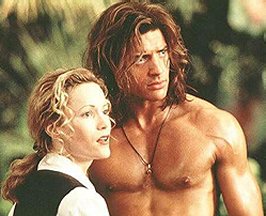
Funke, Cornelia. The Inkheart series, the Ghosthunters books, Dragon Rider, and The Thief Lord. Brendan Fraser narrates some of these, and he has a nice voice for it. But they're no George of the Jungle. (And yes, any excuse will suffice for me to link to a picture of Brendan Fraser in that movie.)
Gaiman, Neil. The Neil Gaiman audio collection. Silly + weird = fun. Don't miss the author interviewed by his daughter at the end.
George, Jean Craighead. My Side of the Mountain. Dated, but still beautiful and exciting. Another one that's kind of hard to find.
Landy, Derek. Skulduggery Pleasant series, read by Rupert Degas. Rupert Degas is my new hero. His characterization of the Troll under Westminster Bridge alone is worth the price of admission. There's an interview with the suave, sarcastic, conceited Skulduggery himself at the end. You know, Rupert Degas also reads Cormac McCarthy's The Road . Brr - if I didn't have kids in the car, I would totally be listening to that.
Law, Ingrid. Savvy.
Lofting, Hugh. The Voyages of Doctor Dolittle . Don't let the interminable, strange, sappy movie spoil this crazy old story for you. There is no Anthony Newley and his fruity accent here.
Lowry, Lois. The Willoughbys. Vellly intelesting narration by Arte Johnson, who, apparently, is still alive.
Rowling, J.K. Harry Potter . Award-winning narration by Jim Dale, who I swear has won every award except knighthood and an Oscar for his work on this series.
Riordan, Rick. Percy Jackson and the Olympians series. Ok, I don't like the reader's brutal Queens accent and extremely poor Greek pronunciation. But I suck it up, because the stories are terrific and the kids LOVE them. And so should you.
Sinden, David, Matthew Morgan, Guy Mac Donald (aka The Beastly Boys). An Awfully Beastly Business (series). The GRRRREAT Gerard Doyle reads these. Can't wait! Book trailer here.
Selden, George. The Cricket in Times Square. Friendly narration by the versatile Tony Shalhoub, lovely violin passages.
Snicket, Lemony. A Series of Unfortunate Events (series). Although this series is no longer the hot ticket in print, I feel like the audio versions will persist in popularity, because of Tim Curry's chuckling, mournful, spitty, insane readings. A depressing yet beautiful and hilarious song by The Gothic Archies is a bonus on each audio book.
Stanton, Andy. You’re a Bad Man, Mr. Gum. A truly distinguished audio book. Read by the author, he takes liberties with his own text, adapting certain 4th-wall-busting asides to the audio format. Plus, my god this book is funny! The red fairy in the bathtub who hits Mr. Gum with a frying pan whenever his garden starts looking messy... brilliant!
Stevenson, Robert Louis. Treasure Island . Alfred Molina ("Throw me the idol, I'll throw you the whip") does for the sound of Treasure Island what N.C. Wyeth did for the look - now, whenever I think of that book, I will hear Mr. Molina's voice. Stevenson's very large and at times obsolete vocabulary (what is a mizzen, anyway?) is a lot easier for kids to digest in the audio context. And Molina is a genius with characterization, by turns silky, gruff, naive, you name it.
Stilton, Geronimo. Read by Edward Herrmann.
Wilder, Laura Ingalls. The Little House books. Cherry Jones reads these, in a timeless voice that is both dry and warm. Even if you know these books well, her perfectly paced performance brings them to life in a new way.
White, E.B. Charlotte's Web and Stuart Little. Julie Harris reads Stuart Little, and White himself memorably reads Charlotte's Web. Beautiful and kind of heartbreaking there at the end.
Winkler, Henry. The Hank Zipzer series. The Fonz reads his own books, and when you hear him do it, you'll think, "Seriously? Somebody cast this funny little guy as a cool motorcycle dude?" The seventies really were a little weird.
Woodson, Jacqueline. Anything she reads herself is always going to be beautiful and affecting.
But a crappy narrator, or a stupid story, will NOT help. I listened to The DaVinci Code one summer in the car and I nearly drove off a bridge in desperation. Oh my god that book was terrible. So - the following titles have been selected as being engaging for adults and for kids, often with superlative narrators, classic appeal, and/or historical interest. Look in your local library for these - they're awfully expensive to buy.
Anderson, Laurie Halse. Fever 1793
.Avi. The true confessions of Charlotte Doyle.
Babbitt, Natalie. Tuck Everlasting
.Balliett, Blue. Chasing Vermeer
, The Wright 3, and The Calder Game. I admit that I'm not a giant fan of the nasal narrator, but don't let that stop you. Probably just me.J.M. Barrie, Peter Pan. Narrated by Mister Jim Dale.
Bruchac, Joseph
. But not for super-little kids - too scary!Buckley, Michael. The Sisters Grimm
(series). Awfully funny and even more clever, although I didn't like the way the sisters sniped at each other in the first book. The kids did though. I'm just too sensitive.Collins, Suzanne. Underland Chronicles
(series).Cooper, Susan. The Dark is Rising (series). IF you can find them. Ably narrated by Simon Jones.
Dahl, Roald
. British A-listers such as Alan Cumming, Eric Idle, Jeremy Irons, and Lynn Redgrave read Dahl’s subversive stuff. As does the author himself.Dowd, Siobhan. The London Eye Mystery
.Fleming, Ian. Chitty Chitty Bang Bang. SOOOO much better than the movie. Hard to find, but worth it. First of all, mom's not dead, she's along for the ride, and second of all, the ride is great!
Funke, Cornelia
. The Inkheart series, the Ghosthunters books, Dragon Rider, and The Thief Lord. Brendan Fraser narrates some of these, and he has a nice voice for it. But they're no George of the Jungle. (And yes, any excuse will suffice for me to link to a picture of Brendan Fraser in that movie.)Gaiman, Neil. The Neil Gaiman audio collection. Silly + weird = fun. Don't miss the author interviewed by his daughter at the end.
George, Jean Craighead. My Side of the Mountain
. Dated, but still beautiful and exciting. Another one that's kind of hard to find.Landy, Derek. Skulduggery Pleasant series, read by Rupert Degas. Rupert Degas is my new hero. His characterization of the Troll under Westminster Bridge alone is worth the price of admission. There's an interview with the suave, sarcastic, conceited Skulduggery himself at the end. You know, Rupert Degas also reads Cormac McCarthy's The Road
. Brr - if I didn't have kids in the car, I would totally be listening to that.Law, Ingrid. Savvy.
Lofting, Hugh. The Voyages of Doctor Dolittle
. Don't let the interminable, strange, sappy movie spoil this crazy old story for you. There is no Anthony Newley and his fruity accent here.Lowry, Lois. The Willoughbys. Vellly intelesting narration by Arte Johnson, who, apparently, is still alive.
Rowling, J.K. Harry Potter
. Award-winning narration by Jim Dale, who I swear has won every award except knighthood and an Oscar for his work on this series.Riordan, Rick. Percy Jackson and the Olympians series. Ok, I don't like the reader's brutal Queens accent and extremely poor Greek pronunciation. But I suck it up, because the stories are terrific and the kids LOVE them. And so should you.
Sinden, David, Matthew Morgan, Guy Mac Donald (aka The Beastly Boys). An Awfully Beastly Business
(series). The GRRRREAT Gerard Doyle reads these. Can't wait! Book trailer here.Selden, George. The Cricket in Times Square. Friendly narration by the versatile Tony Shalhoub, lovely violin passages.
Snicket, Lemony. A Series of Unfortunate Events
(series). Although this series is no longer the hot ticket in print, I feel like the audio versions will persist in popularity, because of Tim Curry's chuckling, mournful, spitty, insane readings. A depressing yet beautiful and hilarious song by The Gothic Archies is a bonus on each audio book.Stanton, Andy. You’re a Bad Man, Mr. Gum. A truly distinguished audio book. Read by the author, he takes liberties with his own text, adapting certain 4th-wall-busting asides to the audio format. Plus, my god this book is funny! The red fairy in the bathtub who hits Mr. Gum with a frying pan whenever his garden starts looking messy... brilliant!
Stevenson, Robert Louis. Treasure Island
. Alfred Molina ("Throw me the idol, I'll throw you the whip") does for the sound of Treasure Island what N.C. Wyeth did for the look - now, whenever I think of that book, I will hear Mr. Molina's voice. Stevenson's very large and at times obsolete vocabulary (what is a mizzen, anyway?) is a lot easier for kids to digest in the audio context. And Molina is a genius with characterization, by turns silky, gruff, naive, you name it.Stilton, Geronimo
. Read by Edward Herrmann.Wilder, Laura Ingalls. The Little House books
. Cherry Jones reads these, in a timeless voice that is both dry and warm. Even if you know these books well, her perfectly paced performance brings them to life in a new way.White, E.B. Charlotte's Web and Stuart Little. Julie Harris reads Stuart Little, and White himself memorably reads Charlotte's Web. Beautiful and kind of heartbreaking there at the end.
Winkler, Henry. The Hank Zipzer
series. The Fonz reads his own books, and when you hear him do it, you'll think, "Seriously? Somebody cast this funny little guy as a cool motorcycle dude?" The seventies really were a little weird.Woodson, Jacqueline
. Anything she reads herself is always going to be beautiful and affecting.
Subscribe to:
Posts (Atom)

 Posts