Showing posts with label fantasy. Show all posts

Wednesday, July 29, 2009

Highway to Hell, a novel by Rosemary Clement-Moore - review

I am woefully behind in my YA reviewing. I have been reading YA books all summer - in part because I like YA books, partly because I got so many YA ARCs at BookExpo, and of course, partly because I like to be able to recommend books to teenagers.

But I haven't been able to bring myself to review them. Sure, Lament: The Faerie Queen's Deception by Maggie Steifwhatever was fine, with romance and uncertainty and music and telekinesis, and the similar but less romance-y Troll Bridge: A Rock'n' Roll Fairy Tale I would recommend without hesitation.

The forthcoming Sphinx's Princess, in which Esther Friesner imagines the pre-royal life of Nefertiti (King Tut's wife) the same way she did Helen of Troy's in Nobody's Princess, was perfectly serviceable clean teen historical romance fiction. The Goldsmith's Daughter, about an Aztec teen who crosses gender lines to protect her family, was terrific - right up until she fell in love with a conquistador. Hey, doesn't everybody love a good-Nazi love story?

I read Pride and Prejudice and Zombies, and I have independent confirmation that YES it is a good choice for young adult readers. Wondergirl, my favorite middle schooler, read it over the summer at my suggestion, then rented the movie and laughed all the way through it. Hee hee hee!

But WHYYY have I not reviewed all these things? What is the MATTER with me? Have I lost my joy in reading and nowadays I am just plowing through these novels for the sake of getting them done? WOE!


Cough. That was probably a little more melodramatic than the situation warrants. Anyway. I am, by contrast, supernaturally excited about this book, the most recent in the Maggie Quinn, Girl vs. Evil series. I am a newcomer to Maggie, her friend D&D Lisa the evil genius, her paladin of a boyfriend, and the trouble - EEEVIL trouble - that seems to dog their footsteps. I picked up the book because I liked the coolio Craig Phillips cover, and because on it, Maggie wears aviator sunglasses while motoring along in her Jeep with no doors.

And now I've just finished it and I'm happy, I'm happy happy happy. Maggie and Lisa are geeky plus good-looking, but in a believable, Kristen-Bell-in-Fanboys kind of way. Their banter is witty but not so witty that it sounds fake. They call each other "moron" with regularity. They are aware that together, they make up Bart Simpson's sisters, and if you point it out, they will roll their eyes so hard they'll almost knock themselves over.

Maggie is psychic and Lisa is a witch, and BF Justin has the looks, the good manners, and the physical competence of a Riley Finn without all the whining. Seriously, I'll never forgive Whedon for what he did to that character. Make him evil, kill him off, but emasculating him like that was just mean.

The plot is TIGHT. There's enough going on that the author could be forgiven for letting a detail or two go unexplained, but she does not. Furthermore, answers are not hurled into the text at the end in any old "Have this droid's memory wiped" manner. They are woven in, sometimes not even overtly. My new pal Rosemary Clement-Moore doesn't seem to think it's necessary for a character to say, "Oh so that's why the demon absorbed that shotgun blast without injury." If it's not a major plot point, she'll let you make that connection yourself, which, I have to say, is extremely generous. If I'd written anything half so clever, you can bet I would be showing off all my tied-off ends like a Boy Scout who just earned his Knots merit badge.

PLUS. Maggie is petite and powerful, and sassy and cute. I'm a geek. But I didn't think of Buffy until page 270, when she tells a giant amalgamated demon who is doing a good job of intimidating her, "You are so full of crap." Of course, now I can't stop.

The book is, somewhat refreshingly, not without God. I am a little weary of the dances that many authors do in order to keep their teen demon-fighting free of any actual discussion of faith. As when Buffy runs into a high school classmate in the cemetery and he asks (about God), "does he exist, by the way? Is there word on that?" and Buffy answers, "Nothing solid."

In this book, Lisa, in particular, is quite concerned about going to Hell after having summoned a demon in a previous book. There are Catholic characters who participate in the Back Demon Back, saying prayers and swinging branding irons.

Our setting is the fictional Dulcina, TX, right down in the foot of Texas, near the Gulf of Mexico. Lucky for us, Clement-Moore knows her Texas. She writes the landscape - its smells and sky, its few features, the effect livestock has on it, and most of all its subtle rises and falls - really well, with unstrained, natural imagery. You get the feeling she's spent some time on a horse.

(I briefly became a little concerned that the "Moore" in "Clement-Moore" was as in Christopher Moore, which would make sense, kind of like when I found out Justine Larbalestier and Scott Westerfeld are married, but looks like not. Apparently, though, she and I are the same person, because she lists Television Without Pity and Go Fug Yourself as good wastes of time, and Susan Cooper and Meg Cabot - whose blog writing I thought of more than once while reading this book - as hero authors. Plus she liked Firefly. Awww.)

Funny and smart, exciting and hip, Highway to Hell was just the squirt of lime I needed to cut through my midsummer complacency.

Saturday, January 3, 2009

Foundling and Lamplighter (Monster Blood Tattoo) by D. M. Cornish - review


Author D.M. Cornish has a passion for neologism. His Latinate and Germanish terms sparkle through the first two books of his series Monster Blood Tattoo like the bubbles in champagne. Maybe, then, we can commission him to come up with a term for the tiresome literary state, common in Greek tragedy and really crappy mysteries, that happens when readers figure out a character's Big Secret long before the character does.

Rossamund, a gentle, short orphan conscripted into dangerous service in a fancy, fanciful land peopled by everymen (humans) and untermen (monsters), does not know the truth about his origins. But we do. We figure it out a few hundred pages into the first book, and by the end of the second book, which, by the way, is over 600 pages long not including the extensive glossary, Rossamund has not figured it out himself.

On its own, this is not a fatal flaw. After all, everyone knows what's going to happen to Oedipus a quarter of the way into his play, and he doesn't figure it out til almost the end, and this knowledge only adds to the tragedy of Oedipus Rex. But in Monster Blood Tattoo, the machinations that the author goes through to delay Rossamund's epiphany feel like they are thrown in his path merely to give the book more space to describe the Half-Continent, the world that the author has, by his own admission, spent fifteen years imagining and peopling in his head. You should see the map he drew. Detailed? You'd have to blow that sucker up wall-size before you could even read it.

Listen, I am not against world-building. I have drawn my share of maps, believe me. But there comes a point, if you are writing a book, that the narrative has to take precedence.

Comparison has been made to Tolkein, and I can see why. The world of the Half-Continent is the most completely-imagined fantasy world since Middle Earth, in terms of material culture - maybe even more so. Cornish does all of Tolkein's descriptive work, and adds in much of the incidental detail Peter Jackson had to design when he made the movies - the weapons! the uniforms! the stylistic elements! And, like Tolkein, he has illustrated his world himself - and he is a very talented illustrator.

But the pace and tone of Monster Blood Tattoo has very few ups and downs. What Cornish does not do as well as Tolkein - and I make the comparison only as a shortcut, I don't mean to imply intent - is this: when Frodo, in his wanderings, encounters new subcultures and meets new people, Tolkein manages to bring most of these people alive in a few strokes. Rossamund moves about quite a bit as well, but most of his transient comrades seem all but interchangeable. Young guy, old guy. Mean guy, nice guy. Plus, there is not one smile to be had in either of the books so far. The bleak tone never lets up. It's like the trip to Mount Doom all the way, with no Sam Gamgee to occasionally crack us up, or at least cook us breakfast.

I will recommend these books to ravenous fantasy readers, but as spectacular examples of obsessive vision, not as adventure literature per se.

Saturday, November 29, 2008

The Lost Island of Tamarind by Nadia Aguiar - review


The Lost Island of Tamarind by Nadia Aguiar
Oh, boy! Oh boy oh boy oh boy! For kids who like their adventure with a little adventure thrown in, with a shot of adventure in a test tube shoved down in the middle to add in later after the adventure gets diluted by the melting ice!

No, wait, that's a Key West piña colada - there is no ice in this book. BUT - the Lost Island in question, somewhere within the Bermuda Triangle, IS vivid and unpredictable, full of characters who are lost, or found, or looking for their lost shaker of salt... just like Key West. Instead of Hemingway's six-toed cats, there are flying fish and giants and thuggish apes.

And not only is the setting marvelous - with a fabulist retro vibe reminiscent of Jules Verne, H. Rider Haggard, or Edgar Rice Burroughs - but the characters are full, modern, and believable. Our heroes are Maya and her younger brother Simon, who have been stranded on the island after their marine biologist parents were swept overboard in a storm. In some ways they are your typical brother-sister team (think Cryptid Hunters, The 39 Clues, The London Eye Mystery), sometimes chafing against each other, sometimes working together as smoothly as only family can. But these characters have an astringent emotional core: their mom and dad are missing, and Maya and Simon are worried. Too many books and movies get the parents out of the way so that the plot can proceed, and you could almost forget that there ever were parents. Not so here: Maya's anxiety wafts through The Lost Island of Tamarind like acrid smoke through the jungle.

In addition, the kids are carrying and caring for their baby sister, who, although a remarkably easy-going nine-month-old, is not some super-baby à la Sunny in A Series of Unfortunate Events. The hardships faced by these young people ring true, and they surmount them using skills consonant with their background and age. Having grown up on a boat, they both can read a ship's log and navigate (and change a diaper), and Simon is a star at knots, but neither is a genius, and they each have their flaws.
I have been pressing The Lost Island of Tamarind into the hands of every eager reader who has come my way recently. There are enough ooh-aah moments (mermaids!) to satisfy the fantasy readers, but not so many as to put off the anti-swords contingent. It's astonishing to me that this is Nadia Aguiar's first book: the sweet, lush setting and the sharp, clean characters make one fine tropical cocktail. I want another.

Sunday, November 16, 2008

Marveltown by Bruce McCall - review


Marveltown by Bruce McCall
When I plucked this big sunny square off the Professional Review shelves at work and surveyed the faux- Fifties Futurist paintings, I flashed back to pulling old books on rocket science off my Dad's shelves when I was a kid. The illustrations in those books were so intriguing - immense curved structures with impossibly thin floors and spires, a few tiny humans scratched in to give them scale; cratered surfaces and craggy mountains; big control rooms stocked with banks of giant flanged capacitors and oversized dials... but the books would always disappoint. I would expect breathless stories full of firecracker surprises, but... there was a lot of nonfiction in our house. Those books would actually be about rocket science. Lots of parabolas and charts.

I shook my head paging through Marveltown, thinking that Bruce McCall had a lot of fun creating a catalog of outscale inventions, and thinking that just drawing lots of cool stuff does not make a book.

What a fantastic surprise, therefore, to turn a page and, beneath a painting of a huge control room with banks of flanged capacitors and oversized dials, see the words, "Until one quiet midnight..." A story! A robot rebellion! Yeah!!

I couldn't wait to get Marveltown home to my boys. I wanted to see whether my enthusiasm was purely based on my retro-futurist nostalgia - ideas of the future that were old when I was a kid: Helmut Karl Wimmer's paintings from the old Hayden Planetarium, which came down when I was working at AMNH; the illustrations of Frank Tinsley and Chesley Bonestell; the villain's control room in old Bond movies; silly stuff from very old MAD magazines. There's a picture in Marveltown of a terrified guy in a hat, his pipe flying from his mouth as he runs screaming, that I think is a direct quote from a Kelly Freas painting.

The interesting thing about Bruce McCall, in this context, is that Wikipedia says the man is 73 years old - same age as my Dad. These illustrators that I am all nostalgic over... their careers overlapped his. These ARE his visions of the future. Makes Marveltown extra-sweet to me.

So let's hear from our panel. Here's what the boys said as Mao read the book aloud:

"It's supposed to be the kids are the run-away-ers and the grownups are the stayers, but it's the opposite!"

"How about they don't make living robots, they just make working robots?"

"Whoa, that's what somebody invented?" (about a tall crack-the-whip Maypole kind of thing that... ok yeah I can't describe it)
"That is totally better than a big robot."

"The ripple-rug was my favorite invention."
"The metal dog who ate everyone's homework was my favorite, because he was a great guard dog."

Does it make you want to invent things?
"Makes me want to want to turn our LEGOtown into Marveltown! With giant robots! With a couple different things, with the robots only attacking three grownups - bad guy grownups - not Skeletor, because he's dead. They would attack Larry Jenkins, 50-foot Spreitel, and The Boss."

Ok, so... any questions?

Thursday, October 2, 2008

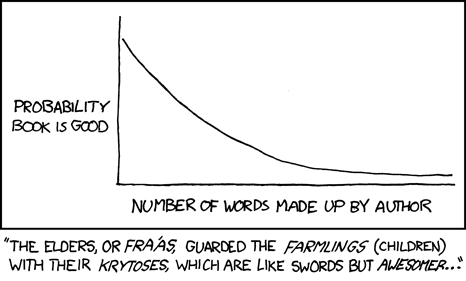
xkcd sums it up


With notable exceptions (Susan Cooper), you could draw this same graph with "Number of ordinary words appearing with an initial capital" on the x axis.

The Realms. The People. The Curse. The Land. The Plumber. The Ennui!

Monday, September 22, 2008

Walt Disney's Alice in Wonderland, retold by Jon Scieszka, pictures by Mary Blair - review


Walt Disney's Alice in Wonderland, retold by Jon Scieszka, pictures by Mary Blair
Now here's a coincidence worthy of Lewis Carroll: I just last night finished reading the AMAZING graphic novel Alice In Sunderland by Bryan Talbot, an encyclopedic look at the history of Sunderland, in the northeast of England, informed by the lives of Charles Dodgson and Alice Liddell. It is loaded with information both interesting (George Washington's family crest was stars and stripes) and trivial (Bilbao's football team was founded by emigre Sunderland factory workers). History braids together like a slow river in that book.

Talbot is, among other things, something of a collector of versions of Alice. Toward the end of Alice in Sunderland, there must be four pages with tiny thumbnail representations of the covers of those books, and he is alarmed and amazed when he hears a rumor that Kelly Osbourne (Ozzy's daughter) is coming to Sunderland to film something called Malice in Sunderland.

The book is so dense and so layered that it left me feeling a little spacy. Good graphic novels do that to me - I get so caught up in the narrative and the drawn world of the novel that I walk around preoccupied and ditzy for a little while.

So I was a bit suspicious when I saw the above book on the shelf. It's not another retelling of Alice's Adventures in Wonderland, no, it's a retelling of the Disney movie "Alice in Wonderland." "How meta," I thought to myself. "And just when you've finished, like, a meta Bible on Alice. You are making this up."

But no. What it is, though, is another labor of love based on Alice. Mary Blair, creator of the freaky character designs for "It's a Small World," did the original concept work for the Disney movie. These paintings, full of movement and drenched with color, have been resurrected for this edition, with a fine story condensation by National Ambassador for Young People's Literature Jon Scieszka, whose name I can finally spell correctly on the first try. "Salaam, Mr. Ambassador! Please continue to use your great power for good!"

(Although I really have to admit, I never liked Alice in Wonderland. Freaked me right out.)

Saturday, July 12, 2008

Vacation reading

Ah! We are back from two weeks in various cities and beaches in the American Southeast, and did we have time to read? We did!

I read:


So Yesterday by Scott Westerfeld
Loved it! The whole "cool hunter" thing is a bit nineties, but you gotta love a good mystery, and a good mystery that is full of cool stuff is even better. Also, Westerfeld's examination of the co-opting of youth trends for mass consumption is straight out of Commodify Your Dissent, a compendium by the folks at The Baffler that every teenager should read before cracking that next can of Monster Mixxd Energy Juice.

Little Brother by Cory Doctorow
(reviewed while I was on vacation in New Orleans, thank you very much)

Farthing by Jo Walton
Technically a grown-up book, I would recommend Farthing to any young adult reader interested in speculative fiction, history, or mystery. It's an illuminating "what-if" novel set in an England that has accepted Hitler's "Peace with Honor" - disguised as an old-fashioned English country house mystery: Gosford Park meets Brazil. There are many discussions involving sexuality, i.e. who is homosexual and who is not, but no sex.

The Nasty Bits: Collected Varietal Cuts, Usable Trim, Scraps, and Bones by Anthony Bourdain
Essays by the author of Kitchen Confidential and The Bobby Gold Stories. I recommend the crap out of Tony Bourdain - but not, typically, for kids. There's the language, not to mention the extremely frank talk about sex and drugs. There are some teenagers, though, especially the ones considering restaurant careers... hey, they should know what they're getting into!


My rising 2nd grader read:


Black Lagoon adventures, books 1-7 by Mike Thaler ; illustrated by Jared Lee
The kid is giggling to himself as he goes through and then reading passages out loud to his younger brother. I'm taking that as a thumbs-up.


My husband read:


How the States Got Their Shapes by Mark Stein
Recommended road trip reading. At every state border, as we hollered out "Good-bye, Georgia!" and "Hello, Alabama!" Bob would have some anecdotal treasure to relate about battles, topography, bureaucratic snafus, and the duplicitousness of Virginia. Luckily, he kept most of them to himself. (I kid! I kid!)

Also, he read The Economist. Also the newspaper. On the beach. I swear, one of these days I'm going to strap him to a chair and force Robert Ludlum down his throat. Or... eww.


On audio:
Our faithful minivan transported us a grand total of 2875 miles. And did we listen to books in the car? We did!


We spent most of our time in the car with Percy Jackson and the Olympians by Rick Riordan. We got through The Lightning Thief, The Sea of Monsters, and The Titan's Curse.

My boys, who are 5 and 6 years old, now know the traits and attributes of all the major Greek gods and a fair number of the minor ones. They cried out for "more Percy" every time we got into the car. Unfortunately for my husband and I, the narrator, Jesse Bernstein, is... well. In addition to a gritted-teeth Queens accent that would make Archie Bunker proud (shtreet, frushtrated, firmiliar, foward, bedgeroom), the guy continually misplaces the emphasis in sentences and phrases. Also? A word to audio book producers? When your narrator encounters the word "ichor" and pronounces it "icker"? Stop the tape and look it up. He does animal voices really well, though.


And at bedtime:
Since the boys share a room, I can read to them both at bedtime, usually a long chapter book, while they fall asleep in their beds. I have read Nurse Matilda, The True Meaning of Smekday, and A Hat Full of Sky in this way. My Boov voice was irresistable, as I predicted, but the Nac Mac Feegles nearly did me in.


On the road I started reading the second Skulduggery Pleasant book, Playing with Fire. I am pleased to report that it is starting out just as sardonic and action-packed as the first book, and I am proud to say that I am working Skulduggery's deep velvet voice almost as well as Rupert Degas, who read that first book so amazingly well that we replayed sections again and again.

Here's to beach chairs, lounge chairs by the pool, couches in shady living rooms. Anywhere you get a chance to just sit and read. That's vacation, baby.

Thursday, May 8, 2008

Trainstop by Barbara Lehman - review


Trainstop by Barbara Lehman
I am not always completely gung-ho about Barbara Lehman's books. Oh, I like them myself, and I always spend a little while reading and admiring, and... then I put them back on the shelf. They're just not all that accessible to little kids, and bigger kids usually pooh-pooh them because they're wordless.

But Trainstop is a bit less abstract than The Red Book or Museum Trip. A little girl takes the subway with her parents, and after her parents doze off, the train stops at a beautiful land populated with adorable little people, who are possibly toys.

She gets back on the train, which continues on its regular route, but then is visited by a couple of the tiny people after she returns home.

In her author's note, my fellow Pratt alum Barbara Lehman mentions that she used to work for the Transit Authority, "making books about using the subways to get to school." There's a page in Trainstop that shows the little girl looking excitedly out the subway window as the subway goes through the city, into the tunnel, then out of the tunnel and into the sunny magic world. That's a page drawn by a person who loves the subway - I would recognize that kind of person anywhere.

Monday, April 28, 2008

Where's my cow? by Terry Pratchett, illustrated by Melvyn Grant - review


Where's my cow? by Terry Pratchett, illustrated by Melvyn Grant
Not merely a book for fans of Discworld (I haven't gotten around to those books, but my colleague Token Boy Librarian assures me that this book is one big in-joke if you've read them), Where's my cow? is a hoot for any parent who has mentally picked apart the drivelly book that they have had to read every night for 3 months because the kid can't go to sleep without it (Little Toot? I'm talkin' 'bout YOU!), and, if my kids are any indication, Where's my cow? is pretty frickin' funny for any child over, say, 4, as well.

The dad in this book, Sam Vimes (a dead ringer for the actor Pete Postlethwaite, leading me to futz around in imdb for a good twenty minutes trying to figure out if there's finally going to be a Terry Pratchett movie), has to read the dopey "Where's my cow?" to his baby boy every night.
Where's my cow
Is that my cow?
It goes, "Cluck!"
It is a chicken!
That's not my cow!
Although he enjoys all the baa-ing and clucking and oinking that the reading requires, at length Sam begins to deconstruct the text: not only is the book teaching poor observation and problem-solving skills to Young Sam, but also he questions the utility of demonstrating the characteristics of livestock to his son, a city kid. Sam reckons that the only sound Young Sam will ever hear from a farm animal is "sizzle!" when that animal is en route to the dinner table.

So Sam makes up his own take on the book, calling it "Where's my daddy?"
Where's my daddy?
Is that my daddy?
It goes, "Bugrit!"
It is Foul Ole Ron!
That's not my daddy!
Young Sam loved the new version, and so did Mr. Four. "I love that it's funny. I do, I really do!" is his review.

Monday, April 21, 2008

What-the-dickens : the story of a rogue tooth fairy, by Gregory Maguire, read by Jason Culp - review


You know how sometimes, when you're reading a story that takes place in an imaginary world, the imaginary world is so fascinating that the story itself is really a bit secondary? Un Lun Dun was like that for me.

And sometimes, the imaginary world is so fascinating that you wish the author would spend more time exploring it and, actually, less time with the plot. I always wanted to know more about Neverland, for example, and I think that I'm not alone - witness Dave Barry's Peter books and Geraldine McCaughrean's (much better) Peter Pan in Scarlet.

But in What-the-Dickens: The Story of a Rogue Tooth Fairy, Gregory Maguire maybe takes this concept a little too far.

The title character is a 3-inch-tall fairy born all alone and with no conception of who or what he is. He meets four different species of animal (including one human) before running into another fairy, who explains that he is a tooth fairy and introduces him into the totalitarian, hivelike tooth fairy society. What-the-dickens, with his questioning nature, soon learns just about all there is to know about this world, from birth to death, and so do we. In blinding detail. The lessons we learn about the tooth fairy caste system are hammered home with a big fat sledgehammer.

Meanwhile, the plot, such as it is, lurches slowly forward, dragging all this exposition like a fully loaded shrimp net through shallow water. In addition, the tooth fairy story is bracketed by a framing story that, right up until the end of the book, seems much more interesting than whatever's happening to What-the-dickens. Three children and an older cousin are stranded in their house in the middle of an apocalyptic storm, with no electricity and little food. Isolated to begin with by their fundamentalist parents' beliefs, Zack and Dinah struggle with their parents' teachings and with each other as they huddle together with their baby sister through a dark and stormy night, aided by their more secular cousin, Gabe, and his diverting tooth fairy story.

I kept waiting for the story to get back to them. Unfortunately, the book comes to a grinding halt just as dawn breaks and headlights are seen through the window. While they wait for nothing else to happen, Dinah quizzes Gabe about what's going to happen to the tooth fairies next, and then she answers her own questions based on what she remembers of the story. It's like a Teacher's Guide inserted right into the book, and we are meant to use this technique to speculate about what is going to happen to Dinah and Zack. But this is leisure reading, not a reading comprehension test - we bought the book to be Told a Story.

Gregory Maguire, whose work I usually like, just loves politics. In Wicked, he fed poor Elphaba through societies governed under a variety of systems so that the reader could experience each system's flaws first-hand. Even the marvelous Dream Stealer had its share of political examination.

This kind of display of allegorical virtuosity is ok if it advances the character, as Wart's experiences among the animals teach him about governance in The Once and Future King, but any lessons What-the-dickens learns from his observation of the fairies' militaristic collective (and it's not clear he's learned anything except he doesn't want to be among them) don't alter the course of the action until the very end.


The labored, drawn-out, oddly truncated end.


Wednesday, April 9, 2008

Un Lun Dun by China Miéville - review


I found an interview with China Miéville on YouTube in which he describes Un Lun Dun as falling within the tradition of the unexpected journey / heroic quest book. This is definitely true - substitute a dank boiler room for an ornate wardrobe or a rabbit hole (hello up there!), and you're on your way. Fans of books like that will love Un Lun Dun.

However. Un Lun Dun subverts a whole batch of those tropes, starting with the "Prince of the Blood" thing. Aren't you a little tired of the quiet but beautiful kid inevitably turning out to be something greater once removed from her own context?

In this book, the prophesied Chosen One gets bonked on the head in the first fight and is out of the action. Hey, a surprise! Not only does this make room for a less obvious hero to emerge, but it pitches all the other characters' preconceptions about the coming conflict into a cocked hat. Plus, we the readers don't have to suffer through an endless series of riddling prophesies and seemingly pointless quests whose Real Lessons are revealed Later.

That's all well and good for aficionados of this type of book, who will revel in the classic plot devices turned upside down and shaken like British babies. But I will be shoving this book at all kinds of readers (including adults) - I think that it packs in so many mini-elements of delight and mystery (there's a term for this, and I forget what it is), that any reader will be hooked from page to page. You find this in Suzanne Collins' Gregor the Overlander books, and, most spectacularly, in Harry Potter.

That video is a little disconcerting, isn't it? China Miéville looks like Woody Harrelson in Natural Born Killers.